The Simple List That Made Me Reliable
I want to tell you about the least impressive tool I've ever built. No dashboards, no clever automation. Just a running list of action items. And it might be the single thing that's done the most for how people see me at work.
The problem nobody admits to
The hardest part of the job isn't the hard part — it's the small part. The dozen tiny commitments you make in a day: "I'll check on that," "let me confirm and get back to you," "I'll follow up after the call." They scatter across meetings and threads and, somewhere between Tuesday and Thursday, quietly evaporate.
Nobody fails at the big deliverable. People fail at the follow-up. And the dropped follow-up is the one people remember — deliver a release flawlessly but forget one promised summary, and the summary is what sticks. Reliability isn't built on big wins; it's eroded by small misses.
So I built a place where nothing could slip.
What it is (almost embarrassingly simple)
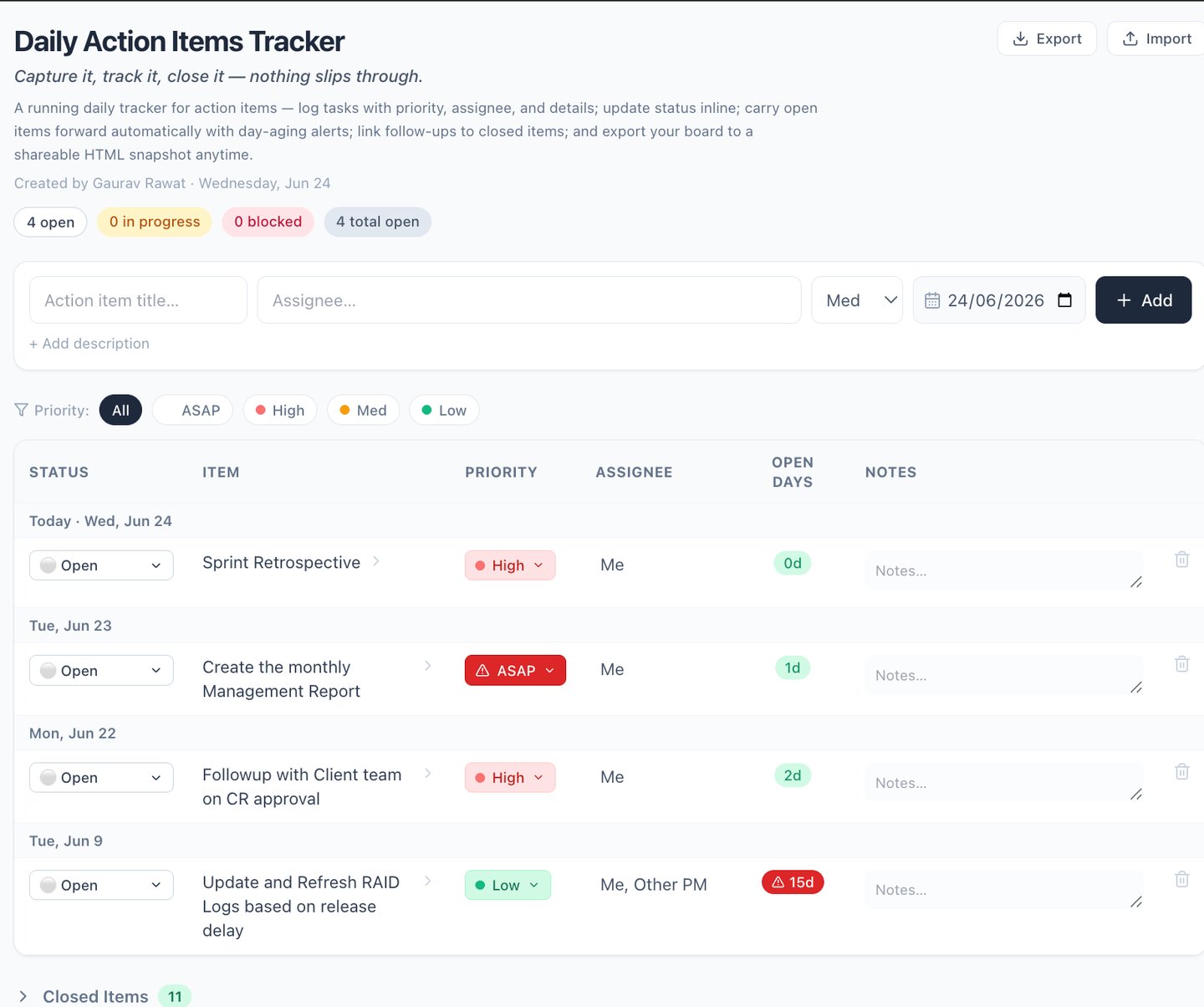
A list. Each item has a title, a priority, an assignee, a note, and one number I care about most: how many days it's been open. Everything's editable inline. You could describe it in a sentence.
But three small choices turned a plain list into something that changed how I work.
It ages things for me. Every open item carries its age, and the colour climbs — green, amber, red, then a critical warning past two weeks. The oldest, most-ignored commitments become the loudest things on screen. I don't have to remember what's going stale; the list nags me on purpose.
It carries forward. Open items roll into the next day automatically, age climbing. Nothing falls off because a day ended — the only way an item leaves is when I close it.
It chains. This is the part I'm proudest of. Most lists treat "done" as the end. But work doesn't end when an item closes — it evolves. A vendor evaluation closes, and now you negotiate the contract. So when I close an item that spawns a next step, the two stay linked. Follow the chain back, and you see the whole history of how a piece of work travelled. Months later, when someone asks "why did we do it this way?", I don't dig through buried threads — the chain already holds the answer. The list doesn't just tell me what's open; it tells me the story of how we got here.
Why simple was the point
A tool you have to maintain is one you'll abandon. This one stuck because it asks almost nothing of me — the discipline lives in the habit, not the complexity. (The whole board exports to a clean HTML snapshot anytime, so the data's always mine — my status report, my backup, my safety net.)
The systems that actually change your working life are rarely the impressive ones. They're the simple ones you're still using a year later, because they're simple.
What it gave me
Not time saved — that was never the point. It was that the low background hum of am I forgetting something? went quiet. Every loose thread now had a home outside my head. If it mattered, it was on the list. If it was on the list, it wasn't getting lost.
Being someone people rely on isn't talent or heroics. It's that you don't drop the small things. Build a simple place to catch them, keep using it, and reliability stops being something you strain for — it just becomes how you work.
Capture it, track it, close it — and nothing slips through.
The idea, if you want your own: age your open items so the stale ones surface themselves, carry them forward so nothing falls off, and link closed items to the ones they spawn. Build it in whatever you already use. Happy to talk through how. [Let's talk →]
The Simple List That Made Me Reliable